Why the Best Events Feel Safe Without You Noticing |
Master event security strategy with a focus on proactive crowd safety. Learn why the best security is the kind guests don’t notice, featuring insights on environmental safety signals, crowd density management, and the "architecture of calm." Explore how to reduce incidents by 30% through smarter event venue design and staffing
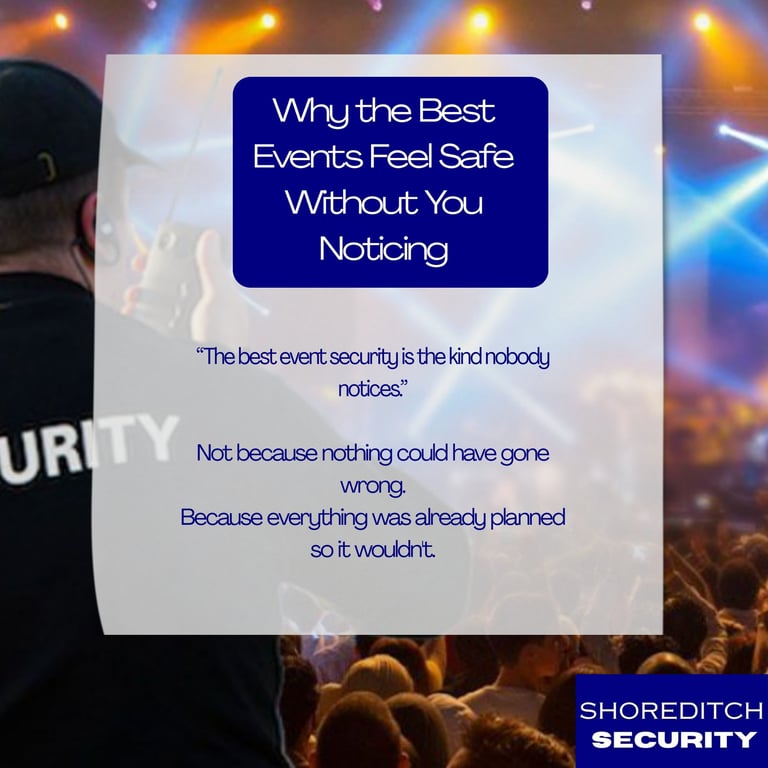
Picture your last really good event. Everything felt right — the vibe, the crowd, the way you moved through it. You felt comfortable without really knowing why. No one told you to feel that way — it just happened. But that feeling wasn’t luck. It came from careful planning done long before you arrived.
Top event planners — from major festivals like Glastonbury Festival to large corporate events with thousands of guests — all agree on one thing: the best security is the kind you don’t notice. If people start paying attention to it, something has already gone a bit wrong.
This idea is what separates average events from truly great ones. And it’s more important than many people realize. Invisible security doesn’t mean less safety — it means better, smarter planning. It’s what happens when every part of the experience is carefully thought through before guests even arrive.
This is for anyone who’s ever wondered why some events feel effortless — and others, for reasons nobody can quite put their finger on, don’t.
The Psychology of Feeling Safe
Humans are remarkably good at reading environmental cues, even when they’re not consciously aware they’re doing it. The way a space is laid out, whether queues feel orderly, how staff make eye contact, whether the people managing the crowd seem calm or on edge — all of these signals feed into a guest’s sense of security before a single word is spoken.
Professor John Drury of the University of Sussex is one of the UK’s leading researchers in crowd psychology. His work — which has informed responses to events ranging from the annual Hajj to the aftermath of the July 7th London bombings — consistently demonstrates that crowds respond to perceived identity and authority rather than just visible enforcement. When people feel part of a shared experience, they regulate each other’s behaviour naturally. When they feel policed, the dynamic shifts entirely.
This has profound practical implications for event design. Security personnel who approach their role as crowd facilitators — people who give directions, answer questions, and manage flow — create entirely different outcomes than those who operate primarily as deterrents. The crowd reads the signal being sent and responds accordingly.
The Global Crowd Management Alliance has formalised this thinking into operational guidance. Their field research recommends branding security personnel as ‘crowd safety’ rather than security, communicating in a friendly, helpful tone, and providing genuine informational value to guests. These are small changes that shift the entire dynamic of how a crowd relates to the people managing it. In practice, the results are measurable — both in incident reduction and in guest satisfaction scores.
There is also a more instinctive dimension to this. Guests at an event — particularly a large one — are running a continuous ambient assessment of their environment. Is this space manageable? Do the people in charge know what they’re doing? If I needed help, would I know where to go? When the answers to those questions are yes, guests relax. When the answers are uncertain, anxiety builds. That anxiety shapes the entire experience, often without guests being able to articulate why they didn’t enjoy themselves.
“The moment guests start noticing security, something has already gone slightly wrong. The goal is not deterrence — it’s invisible assurance.”
Invisible Doesn’t Mean Absent
This is the biggest misunderstanding. When event professionals talk about invisible security, they don’t mean fewer staff or a more relaxed setup. In fact, it’s the opposite.
Invisible security takes more planning, better training, and tighter coordination. It only feels effortless to guests because a lot of hard work has already been done behind the scenes.
Here’s how it usually works. Many top security teams now use a mixed approach: about 70% of staff in uniform and 30% in plain clothes. The uniformed team provides a clear, visible presence so guests know where to go if they need help. The plainclothes team blends into the crowd, quietly watching for issues and stepping in early before anything becomes obvious.
This combination works better than having lots of highly visible security everywhere. By 2025, many high-end event clients were already choosing this lower-profile style over more heavy-handed setups. Why? Because overly visible security can change the mood of an event — and not in a good way.
When people feel watched, they tend to relax less and enjoy themselves less. Even if nothing goes wrong, the experience can feel uncomfortable. But when security is balanced — clearly there, but not intrusive — people feel safe without thinking about it. And that allows them to fully enjoy the event.
Environmental Safety: The Architecture of Calm
Safety at events isn’t just about the people working there — the physical setup matters just as much. Experts call these environmental safety signals: design choices that help a crowd feel calm, organized, and in control.
These choices aren’t just about how things look. They directly affect how smoothly an event runs — and whether problems arise.
Lighting: Good lighting does more than help people see. It guides where they go, reduces confusion, and even influences behavior. Well-lit entrances, exits, and busy areas help people move more easily — especially in emergencies. Poor lighting is one of the most common (and easiest to fix) risks.
Signage and wayfinding: Clear signs and directions prevent crowd build-up. When people don’t know where to go, they tend to bunch together. Simple, easy-to-follow navigation keeps things flowing and reduces stress.
Crowd density: When spaces get too crowded — around four people per square meter — safety risks increase. Good event teams actively manage this by controlling entry, keeping walkways clear, and spreading people out before it becomes a problem.
Staff positioning: It’s not just about how many staff you have, but where they are. Putting too many at entrances and not enough inside creates uneven coverage. Spreading staff evenly helps maintain a consistent feeling of safety everywhere.
Communication: Fast, clear communication between teams is critical. When staff can quickly share information — across the venue and with emergency services — small issues can be handled before they grow.
Every year, over two billion people attend large events worldwide. Studies show that well-planned crowd management can reduce incidents by up to 30%. That’s a big difference — often the line between an event people enjoy and one they remember for the wrong reasons.
Reading the Room Before It Changes
The best event teams don’t wait for problems to happen — they spot early warning signs and act before anything goes wrong.
Crowds usually follow predictable patterns, and trained staff learn to notice small shifts from within the crowd itself, not just from a distance. These shifts might show up as certain areas becoming more crowded without easing, sudden changes in noise levels, or a noticeable difference in how quickly people are moving. Sometimes it’s even an unusual stillness — moments when a crowd that should be flowing suddenly isn’t. Each of these signs can be managed if they’re caught early, but if they’re missed, they can build into bigger problems.
This is why the human element of security is still so important. Technology like CCTV and crowd-monitoring systems adds value, but it can’t fully replace human instinct. Experienced staff can often sense when something is off before it becomes visible on a screen.
This highlights the difference between reactive and proactive security. Reactive security deals with issues after they happen, while proactive security works to prevent them in the first place. Preventing problems is always less costly — not just financially, but also in terms of reputation and safety.
Strong teams also prepare long before the event begins. They review potential risks, think about how the specific crowd is likely to behave, and plan for different scenarios. This matters because different types of events create different crowd dynamics. A festival crowd behaves differently from a corporate gathering, just as a standing concert feels very different from a seated event. The best planners understand these differences and build their approach around them from the start.
Proactive security prevents incidents. Reactive security responds to them. The gap between the two — in cost, in reputation, and in human outcomes — is vast.
The Lesson from Brighton Beach
In 2002, a Big Beach Boutique II on Brighton Beach drew about 250,000 people — even though organisers were expecting around 60,000. Exit routes became blocked, and some areas got dangerously crowded. The event pushed far beyond what its safety plan was designed to handle.
And yet, it didn’t turn into the disaster it easily could have been. Later research showed that the crowd itself played a key role in keeping things stable. People shared a sense of identity and purpose — they felt connected to the event and to each other. Security staff who understood this were able to communicate more effectively, even when standard control methods stopped working.
The takeaway isn’t that planning doesn’t matter — it absolutely does. In fact, this event revealed serious planning gaps that shouldn’t be repeated. The real lesson is that understanding your crowd is just as important as physical security measures. Knowing who people are, what they care about, and how they respond to authority can make a critical difference.
A crowd isn’t just something to control — it’s a group with its own behavior and logic. When event teams work with that instead of against it, they have a much better chance of keeping things safe.
This applies to any event, no matter the size. A small product launch and a massive outdoor festival may look very different, but the principle is exactly the same.
What Excellent, Invisible Security Actually Looks Like
For event organisers, venue managers, corporate experience leads, and anyone responsible for putting large groups of people together in a managed space, this is what genuinely excellent event security involves in practice:
• Pre-event crowd profiling: Understanding who is coming, what they expect, where the crowd’s energy is likely to concentrate, and how the specific audience profile affects security requirements. A corporate product launch and a music event require different approaches — not different amounts of security, but different types.
• Security input into venue design: The security team should be part of the layout conversation before the floor plan is finalised — not consulted afterward. Entry flow, exit positioning, sightlines, and bottleneck management are security decisions that masquerade as design decisions. Getting them right at the planning stage costs a fraction of what fixing them during or after an event costs.
• A blended staffing model: The 70/30 uniformed-to-plainclothes ratio provides simultaneous visibility and intelligence. Uniformed personnel create a baseline sense of order. Plainclothes operatives provide the situational awareness that no camera system can fully replicate.
• Real-time communication protocols: Clearly defined communication channels, escalation procedures, and decision-making authority enable teams to respond to developing situations without confusion or delay. Communication failure is one of the most common contributing factors in crowd safety incidents.
• Post-event review as standard practice: The best security operations treat every event as a learning opportunity — not just when something goes wrong, but routinely. What worked? What created pressure? Where did the crowd behave differently from the model? This institutional knowledge compounds over time into a genuine capability advantage.
Safety is a feeling before it’s a fact.
There is a version of event security that treats its job as containing risk. There is another version that treats its job as enabling an experience. The difference between them is not the number of staff or the size of the budget. It is the quality of the thinking — and whether the people responsible understand that in this field, the greatest compliment you can ever receive is that nobody noticed you were there.
That’s not luck. That’s expertise.


Head office: Cremer Business Centre, 37 Cremer Street, London E2 8HD








Subscribe to our newsletter

What Clients Say About Us