Why Attendees Remember Experiences, Not Presentations
According to a December 2025 report by Eventify, 68% of attendees say immersive experiences are the most important element of an event. Post-event surveys show that 72% are more likely to attend future editions based on overall experience rather than keynote sessions. That statistic alone reframes how we should think about event strategy.
You finally decide to attend that event invitation that’s been sitting on your kitchen counter for weeks. You expect the usual — a string of predictable talks about topics you assume you’ll figure out in real life anyway.
But the moment you step into the venue, your expectations shift.
Maybe it’s your favourite brand hosting a striking pop-up installation. Maybe it’s an immersive virtual reality experience pulling you in with a silent invitation to “come closer.” Or maybe it’s a bold, interactive public installation designed for social sharing.
Whatever it is, you’re no longer just attending, you’re experiencing.
By the end of the day, you may not remember every word from the lectures. But you clearly remember how the event made you feel. You remember the atmosphere. The interaction. The surprise. And you find yourself looking forward to the next one.
That’s experiential marketing in action — creating moments that fully immerse people, so the experience stays with them long after the event ends.
What Current Event Data Says
According to a December 2025 report by Eventify, 68% of attendees say immersive experiences are the most important element of an event. Post-event surveys show that 72% are more likely to attend future editions based on overall experience rather than keynote sessions.
That statistic alone reframes how we should think about event strategy.
While organisers invest heavily in: Speaker lineups, Presentation decks, Panel formats, Agenda precision
Attendees rarely describe an event months later by its slides.
They describe:
The energy in the room
How smoothly the day flowed
Whether they felt safe
The quality of networking
The atmosphere during peak moments
That should change how we design events.
Because while organisers still spend months refining speaker decks, the average attendee:
Consumes a daily average of 7.5 hrs of screentime according to the Guardian which could span professional contents.
Attends multiple virtual events annually
Has access to AI-generated summaries within minutes
In an era of information abundance, events that fail to deliver immersion struggle to justify their own existence.
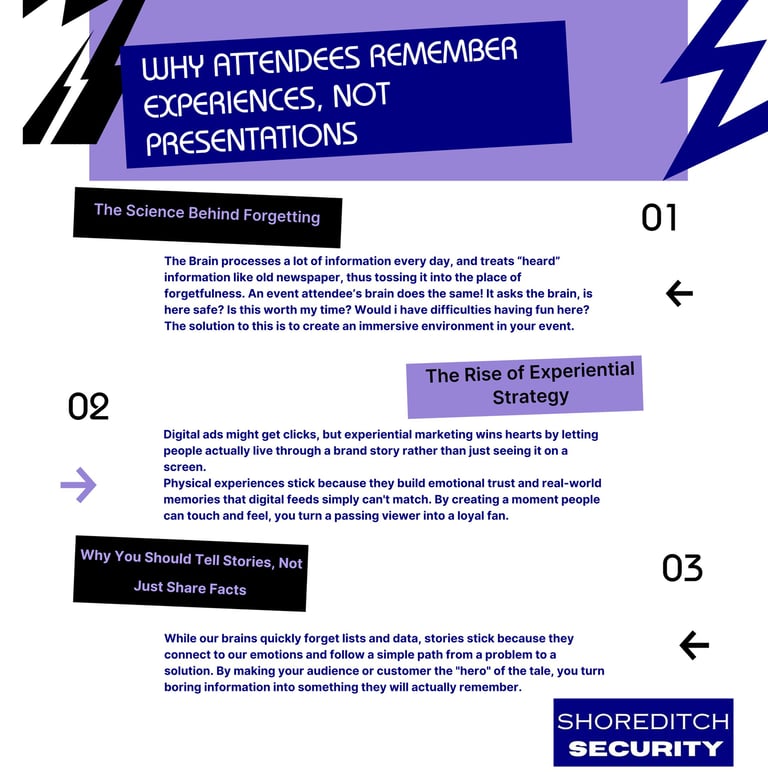
The Science Behind Forgetting
According to research, people tend to forget almost 90% of what they hear within 72 hours. Just think about that. All those hours you spend crafting your deck, all that anxiety about getting every detail right, and your audience will remember less than 10% of it by the end of the week.
A psychologist, Hermann Ebbinghaus figured this out way back in 1885. His famous “forgetting curve” showed that humans lose roughly 50% of new information within an hour, and nearly 90% within a week. Without reinforcement, our brains treat most information like yesterday’s newspaper — worth reading once, then tossing in the mental recycling bin.
But why does this happen? It’s not a flaw in human cognition. It’s more of a feature.
Every minute, our brains process thousands of sensory inputs, thoughts, and memories. If we retained everything equally, we’d be paralyzed by data overload. So our neural networks have evolved to only keep what seems important.
Now, let’s look at this from an attendee’s perspective.
When someone arrives at a venue, their brain immediately starts making quick judgments: Is this organised? Is it safe? Do I know where to go? Do the staff seem confident? Is this worth my time?
When those questions are answered smoothly and without friction, people feel at ease and settle into the experience.
The Experience Economy Has Overtaken the Information Economy
Information is no longer scarce. In this fast-pacing world, too many things are playing catch-up and competing for your time and energy. The same way you feel overwhelmed by the constant stream of information, so often does it apply to your attendees.
Your attendees can access:
Webinars on demand
AI-generated summaries
LinkedIn thought leadership
Industry podcasts
Digital whitepapers
What they cannot download is atmosphere.
The moment someone travels across London for a corporate summit or concert, they are investing time, attention and social energy. They expect something that cannot be replicated on Zoom.
That “something” is immersion.
Immersion is shaped by details people don’t always consciously notice:
Smooth entry and queue management
Comfortable crowd density
Visible, approachable staff
Appropriate security presence
Good environmental control (lighting, sound, temperature)
A strong sense of safety
When these elements work seamlessly, the brain relaxes.
And when people feel relaxed, they:
Network more naturally
Spend more at bars and brand activations
Stay longer
Share more on social media
Associate your brand with professionalism
Immersion isn’t accidental. It’s carefully designed — and carefully managed.
Why You Should Tell Stories, Not Just Share Facts
We get it. You’ve built a 15-slide deck you’re proud of. The information is thorough, carefully prepared, and those visuals look great.
But is that really what your audience needs?
Research in communication studies suggests the average adult attention span is now around 8 seconds. Regardless of the exact number, one thing is clear: holding someone’s attention for any length of time has become increasingly difficult.
Even more importantly, audience focus during presentations typically drops sharply after 8 to 10 minutes unless something changes — tone, format, interaction, or energy.
With shrinking attention spans and constant digital distractions, event organisers can’t rely on slides alone. If you want people to stay engaged, and actually remember why they came — you need something stronger than bullet points.
And few tools are more powerful than a well-told story.
Why go to the trouble of telling stories?
Because if you simply present information, no matter how useful, you quickly hit the limits of how the brain works.
We can only hold a small number of items in short-term memory at once. By the time you start speaking, your audience already has work, messages, and personal thoughts competing for space. Add a long list of features or bullet points, and that mental space fills up fast.
When you present pure information, people try to store it as a list. Within seconds, the list becomes overloaded, and much of it is forgotten.
Stories work differently.
When you tell a story, you engage emotion and memory together. Instead of filing away isolated facts, the brain connects your message to experiences it already understands, like scenes from familiar films such as The Hobbit, Avengers, or Bambi. Stories are easier to absorb because they follow a pattern we recognise: challenge, struggle, decision, resolution.
That’s why stories stick.
Great stories tend to follow timeless arcs — a quest, a transformation, a comeback, a struggle against odds, or a journey driven by love or belief. But structure alone isn’t enough. What makes a speech powerful is making your audience the hero.
If you’re talking about a product, don’t list features. That’s not a story. Instead, find an unusual customer usage case and talk about that. How did the product change that customer’s life for the better? Or talk about the personas of customers that might buy the product and how your audience’s life improves because of it.
Every compelling story has tension and release. A problem and a solution. A before and an after.
That’s what people remember.
Telling stories makes the difference between boring, forgettable speeches, and speeches that people remember. Do the hard work. Find the story. Tell it like only you know how.
The Rise of Experiential Strategy
In a world flooded with banner ads, constant email campaigns, and never-ending social media feeds, brands are competing harder than ever for attention. Digital channels can win you views, clicks, and impressions — but they don’t always win hearts.
That’s where experiential marketing makes the difference.
Experiential marketing is a strategy that directly engages consumers by inviting them to participate in a brand experience. It’s not about talking to consumers — it’s about creating something they live through.
Think of:
A surprise pop-up by a chocolate brand that lets people customise their own bar.
A headphone company hosting immersive silent disco parties across campuses.
An airline recreating airplane interiors in a city centre to let people “fly” to exotic destinations.
These are moments that aren’t just consumed—they’re remembered, shared, talked about, and felt.
After the pandemic, surveys of marketers showed that a significant majority — often cited around 70–80% — view in-person experiences as critical to brand success. Harvard Business Review has highlighted how emotionally connected customers deliver substantially higher lifetime value.
These principles apply equally to events.
Why? Because people trust people.
And one real-world interaction can build more trust than a thousand impressions on a screen.
The Memory Test
Now that we have covered almost everything, it’s time for a quick memory test!
If you want to measure your event’s lasting impact, ask yourself this:
When someone is asked, “How was it?” — what story will they tell?
Will they say:
“The keynote was decent.”
Or will they say:
“It was incredibly well organised.”
“The atmosphere was electric.”
“It felt exclusive and secure.”
“Everything just worked.”
Presentations share information.
Experiences create stories people remember — and stories are what bring them back.
Final Thought
Every event organiser believes their content matters. And it does.
But content alone won’t build loyalty. People remember how they feel, not every slide or statistic.
It’s the flow of the day, the confidence of the staff, the atmosphere in the room — the sense that everything was planned with intention.
In a world where information is everywhere, the real differentiator is the experience.
Events that focus on experience don’t compete with the internet. They compete with nothing.
Atmosphere can’t be downloaded. It has to be lived.
And that’s what keeps people coming back — not what they heard, but what they felt.


Head office: Cremer Business Centre, 37 Cremer Street, London E2 8HD







Subscribe to our newsletter

What Clients Say About Us