
Event steward vs door supervisor: what's the difference?
Published 12 May 2026
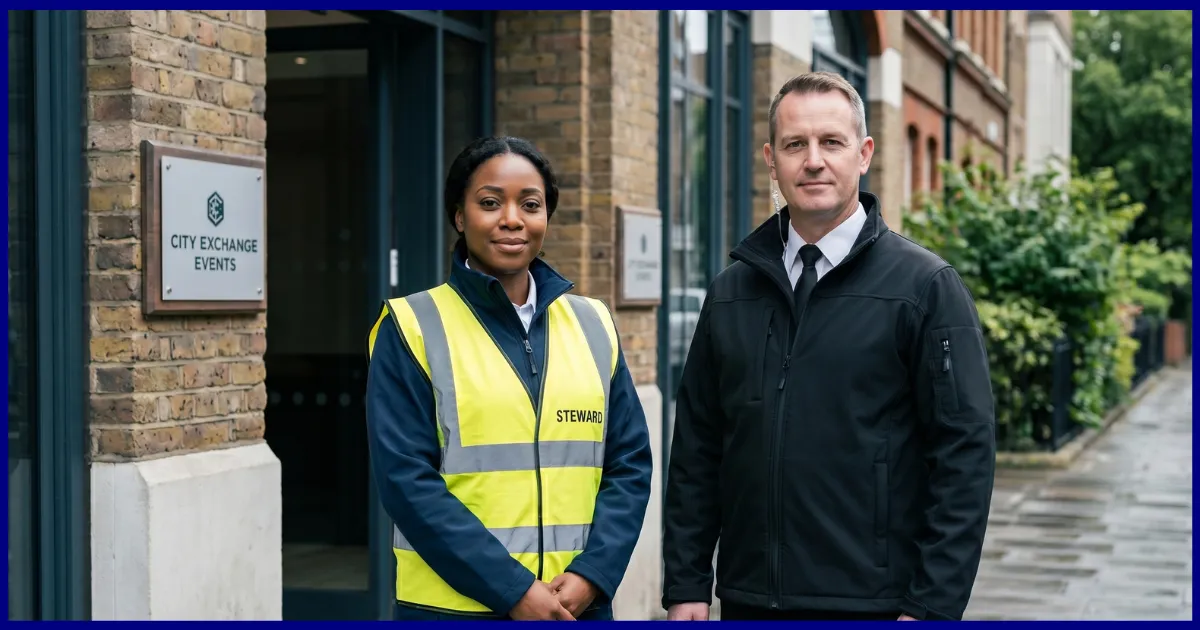
“Do I need stewards or door supervisors?” is one of the most common questions we get — and the answer shapes both your safety and your budget. The two roles look similar from the outside, but they sit on different sides of an important legal line. Get the mix right and you stay compliant while controlling cost. Get it wrong and you either overpay or, worse, leave a legal gap on the door.
This guide explains the real difference, where each role fits, and how a well-planned event blends both.
The short version
An event steward keeps people moving, informed and looked after. They welcome guests, manage queues and car parks, point people to exits and toilets, and keep an eye on crowd flow and welfare. Stewarding is not a licensable activity, so a steward does not need an SIA licence.
An SIA door supervisor does everything a steward can do, plus the licensable work: searching people on entry, managing conflict, refusing entry, and ejecting guests — particularly at licensed premises (anywhere selling alcohol or providing late-night refreshment or entertainment). That work legally requires an SIA Door Supervisor licence.
In one line: stewards manage the flow, door supervisors manage the risk.
Side-by-side comparison
| Event steward | SIA door supervisor | |
|---|---|---|
| Licence | No SIA licence required (NQ-trained) | SIA Door Supervisor licence (legally required) |
| Typical duties | Welcome, queue and crowd management, car parks, signposting, basic welfare, evacuation support | Everything a steward does, plus searching, conflict management, refusing entry, ejections, incident handling |
| Licensed premises | Cannot perform licensable conflict, search or eject duties | Can work licensed premises and carry out licensable duties |
| Typical cost | £16 – £22 per hour | £22 – £35 per hour |
| When to use | Low-risk flow, welcome and welfare roles | Doors, searching, alcohol, conflict-likely positions |
Rates are 2026 guide figures and sit higher for late-night, weekend and central-London work.
What an event steward can (and can’t) do
Stewards are trained — usually to a recognised crowd-safety standard rather than the SIA syllabus — and they’re the backbone of most large events. They:
- Welcome and direct guests, and answer questions
- Manage queues, entry lanes and pinch points
- Run car parks and traffic marshalling
- Monitor crowd density and report issues
- Support evacuation and signpost exits
- Provide first-line welfare and fetch help
What a steward cannot lawfully do is the licensable stuff: conducting searches as a condition of entry, physically managing conflict, or refusing and ejecting people at licensed premises. If those duties are needed, the person doing them must hold an SIA licence — regardless of what their tabard says.
What a door supervisor adds
A door supervisor brings the licensed capability that a steward legally can’t. Because they hold an SIA Door Supervisor licence — which requires accredited training in conflict management, physical intervention, searching and the law, plus a criminal-record check — they can:
- Search guests and bags on entry
- De-escalate and manage conflict
- Refuse entry and remove troublemakers
- Work the door at pubs, clubs, bars and any licensed venue
- Handle incidents and liaise with police
This is why door supervisors cost more: the licence, training and vetting behind the role are exactly what you’re paying for. If you want the full picture of the licensed role, see door supervision explained.
What about “bouncers”?
“Bouncer” is just an old, informal word for a door supervisor — and it carries a dated image of someone big standing on a door. The modern reality is different. Today’s door supervisors are SIA-licensed professionals trained in customer care and conflict resolution as much as physical intervention. Most of the job is calm, polite and preventative.
So if you’ve been searching for a “bouncer”, what you actually need is a licensed door supervisor. The skill set is broader, and the standard is set by law rather than by how someone looks.
How a smart event blends both
Here’s the part that saves money: you don’t need everyone to be licensed. The trick is to deploy licensed door supervisors only where licensable duties actually happen, and use stewards everywhere else.
Picture a 1,500-capacity ticketed event with a bar:
- Door supervisors on the search lines and main entrance, where bags are checked and entry is refused.
- Stewards managing the car park, the queue outside, internal signposting, and welfare points.
You get full legal cover exactly where it’s required, and you’re not paying door-supervisor rates for someone pointing guests to the toilets. Done well, this blend can cut a security bill meaningfully without cutting safety or compliance — it just matches the right person to the right task.
The wrong approach is either extreme: all stewards (a compliance gap the moment searching or conflict appears) or all door supervisors (paying a premium for low-risk flow roles).
Choosing for your event
Work through these quick questions:
- Is alcohol being sold or served? If yes, you almost certainly need licensed door supervisors for the door and conflict-likely positions.
- Are you searching on entry, or running ticketed access? Searching as a condition of entry is licensable — that’s door-supervisor work.
- Is conflict realistically possible? Late nights, crowds and alcohol raise the odds. Plan licensed cover accordingly.
- Is it a low-risk, daytime, alcohol-free event? A stewarding team may well be enough.
Most real events land in the middle — and that’s exactly where a blended plan shines.
Not sure how many of each you need? Our security guard calculator gives a fast starting estimate based on your guest count and event type, and we’ll confirm the right mix with a proper look at your plans.
Get the right mix for your event
The difference between a steward and a door supervisor isn’t just job titles — it’s the line between compliant cover and a legal gap, and between a sensible budget and an inflated one. The best plan uses both, deliberately.
Tell us about your event and we’ll build a staffing plan that keeps you safe, legal and right-sized. Get a quote and we’ll send a clear, all-inclusive figure — usually within a few hours.