
How many security guards do I need for an event?
Published 3 February 2026
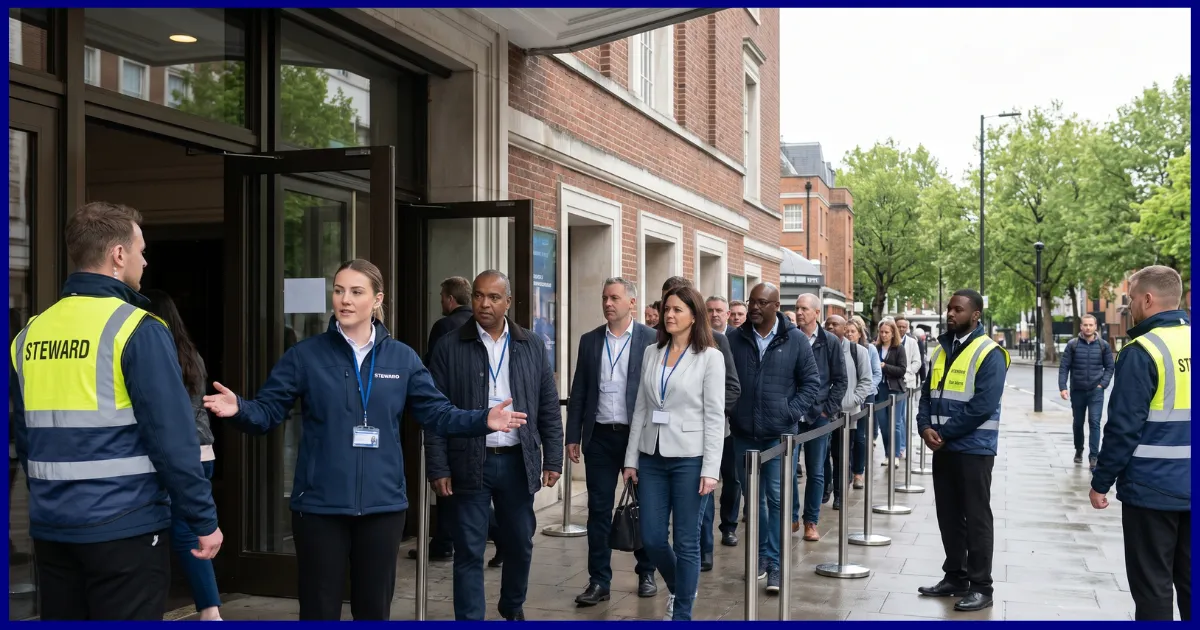
“How many security guards do I need?” is usually the first question event organisers ask — and the honest answer is that there’s no single legal number. Staffing is driven by risk, not a fixed formula. That said, there is a sensible planning baseline you can start from, then scale up or down based on your event. This guide explains how to work it out.
If you’d rather skip the maths, our security guard calculator gives an instant estimate. But it helps to understand what sits behind the figure.
There’s no legal ratio — but there is a baseline
Contrary to a popular myth, UK law does not set a fixed ratio of security guards to guests. What actually determines your numbers is a risk assessment, any conditions on the venue’s premises licence, and recognised industry guidance — most notably the Purple Guide for events and the standards set by the Security Industry Authority (SIA) for licensable roles.
As a starting point for planning, many organisers use a baseline of roughly one officer per 75–100 guests for a low-risk event. Treat that as the floor for a calm, seated, alcohol-light gathering — not a target. The moment you add risk factors, the ratio tightens.
The factors that push numbers up include:
- Alcohol — bars and free-flowing drinks raise the likelihood of conflict.
- Ticketing and public access — open or paid entry means searching, scanning and queue management.
- Late finishes — events running past midnight need more cover as crowds tire and drink.
- Multiple entrances — every door, gate or fire exit you staff adds officers.
- VIPs, cash and high-value stock — these create specific points that need dedicated cover.
- Crowd density and capacity — large, standing or moving crowds need far more staff per head than a seated dinner.
Indicative ratios by event type
The table below is a planning guide, not a rule. It shows typical starting ratios before a full risk assessment refines them for your specific venue and audience.
| Event type | Typical starting ratio | Notes |
|---|---|---|
| Private party / wedding | 1 per 75–100 guests | Low risk, seated, often a small discreet team of 1–2 |
| Corporate event | 1 per 75–100 attendees | Add cover for access control, AV/kit and VIP areas |
| Ticketed / public event | 1 per 50–75 attendees | Searching, scanning and queue management raise numbers |
| Festival (outdoor) | Built from a staffing plan | Gates, stages, perimeter, welfare and overnight all costed separately |
| Nightlife / late licence | 1 per 50–75 patrons | Premises licence often sets a minimum; door supervisors required |
For festivals especially, numbers come from a documented staffing plan — gates, stages, perimeter lines, welfare points and overnight cover each carry their own figure — rather than a single ratio.
Stewards vs licensed officers
Not every person on your team needs an SIA licence, and blending roles is how good plans stay both safe and affordable.
- Stewards handle flow, welcome, signposting, car parks and general crowd movement. These are non-licensable duties, so stewards do not need an SIA licence. See our event stewarding service.
- SIA-licensed officers carry out searching, access control, conflict management and any other licensable activity. Where searching or the likelihood of conflict exists, you need licensed cover — see event security guards.
A practical plan uses stewards to move people efficiently and reserves licensed officers for the doors, search lines and pressure points where they’re genuinely needed. That keeps your headcount right-sized rather than inflated.
Licensing conditions and risk assessment set the minimum
For licensed premises and many ticketed events, your numbers aren’t entirely your choice. The venue’s premises licence may carry conditions specifying a minimum number of SIA door supervisors above a certain capacity, or for events where alcohol is sold late. Those conditions are a legal floor — you can staff above them, never below.
Everything else flows from your risk assessment: the document that records who could be harmed, how, and what staffing controls reduce that risk. The Purple Guide is the reference most UK event professionals use to build that assessment for outdoor and large-scale events. If a licensing authority, venue or insurer asks how you arrived at your numbers, the risk assessment is your answer — not a ratio pulled from a website.
Worked examples
These are illustrative starting points, not quotes or guarantees — they show how the thinking works.
A 120-guest wedding (Home Counties)
A seated, invitation-only celebration with a bar and a 1am finish. Low base risk, but alcohol and a late finish nudge it up.
- Baseline at 1 per ~100 suggests one officer; the late bar and single managed entrance make two discreet officers the sensible plan across the evening.
Most weddings are well covered by a small, discreet team rather than a visible presence.
A 600-capacity ticketed gig (London)
Paid entry, standing crowd, alcohol, a midnight finish and bag searches on the door.
- At 1 per ~60 for a ticketed event, that’s around 10 officers as a starting figure — but the split matters: a search line and door team of licensed officers, plus stewards managing the queue and internal flow.
The exact figure here would come from the venue’s licence conditions and a site-specific risk assessment, not the ratio alone.
How to get your number right
- Start from risk, not a round figure. Headcount is just one input among entrances, alcohol, timing and crowd type.
- Blend stewards and licensed officers so you pay for SIA cover only where it’s genuinely required.
- Check the premises licence early — its conditions may set a minimum you must meet.
- Get a proper assessment for larger events so the plan is documented and defensible.
For a fast estimate, try the security guard calculator, and if you’re also budgeting, see how much does event security cost? for current rates and worked figures.
Get the right team for your event
Every event is different, and the safest number is the one that comes from looking at yours properly. Tell us your venue, guest count, timings and any risk factors, and we’ll build a right-sized plan of stewards and SIA-licensed officers — never over-sold, never under-staffed. Get a quote and we’ll come back with a clear, all-inclusive figure, usually within a few hours.