
Crowd control explained
Published 31 March 2026
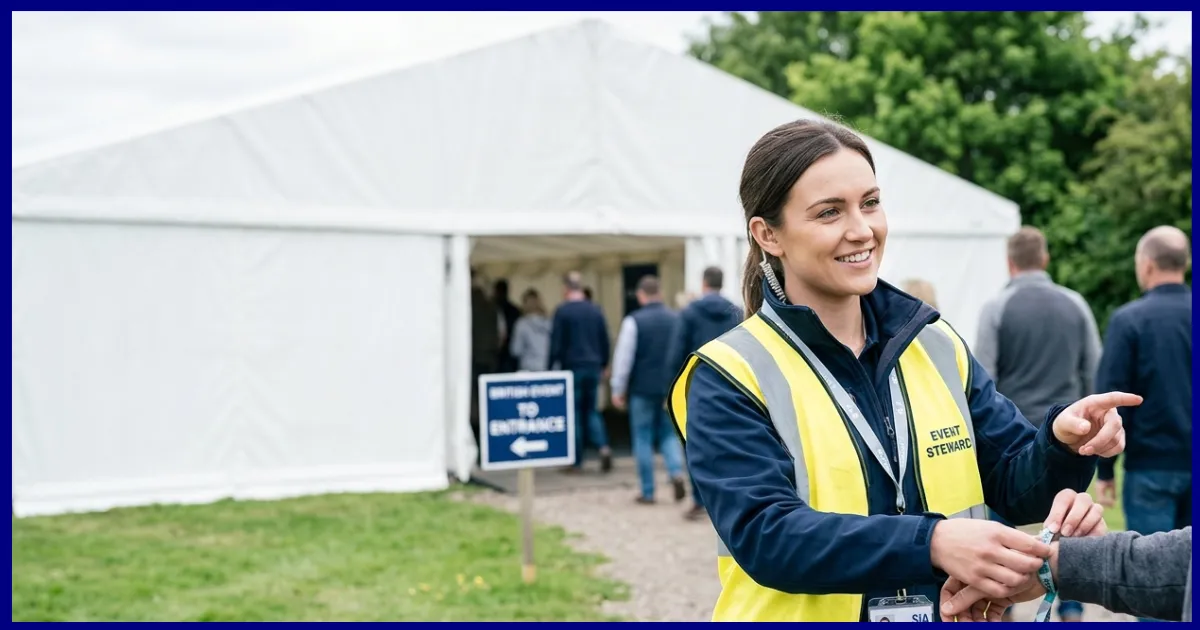
“Crowd control” is one of those phrases that sounds like the whole job — keeping a crowd in order. In practice it’s only a small, last-resort part of keeping people safe, and if you ever need much of it, something earlier in the plan has probably gone wrong. This guide explains the difference between crowd control and crowd management, the safety fundamentals behind both, and why the planning matters far more than the reacting.
If you already know you need help, our crowd management service plans and staffs events of all sizes. But it’s worth understanding what sits behind a good plan.
Crowd control vs crowd management
The two terms get used interchangeably, but they describe different things.
Crowd management is proactive. It’s everything you do before and during an event to keep a crowd moving safely: setting a sensible capacity, designing the layout and routes, planning ingress and egress, deciding staffing numbers, and monitoring conditions in real time so you can act early.
Crowd control is reactive. It’s the containment and redirection you fall back on once a situation is already developing — holding a queue, closing a route, slowing entry, or steering people away from a pinch point. It’s a tool, not a plan.
The relationship between them is the whole point: good crowd management means crowd control is rarely needed. When capacity, flow and monitoring are right, the crowd never reaches the density or confusion that forces a reactive response. Events that lean heavily on control on the day are usually events that were under-planned beforehand.
Crowd-safety fundamentals
Most of the work happens long before the gates open. These are the building blocks.
Capacity and density
Capacity isn’t a single number — it depends on the space, the exits and what people are doing in it. Density is the more useful measure: how many people occupy each square metre. As a planning concept, dense standing audiences are often planned around roughly 0.5 m² per person (about two people per square metre). Push beyond that and people start to lose the ability to move independently, which is where risk climbs sharply. Our crowd capacity calculator gives a quick sense of how space and numbers interact, but a real plan accounts for sightlines, exits and event type.
Ingress and egress
Getting people in and out safely is often the hardest part of an event, not the bit in the middle. Entry needs enough lanes and staff to avoid a build-up outside; exit — especially emergency egress — needs routes that can clear the site quickly even if one is blocked. Both are sized from the expected crowd, not guessed.
Queue design and flow
Queues are where pressure quietly accumulates. Well-designed queues are wide enough not to compress, switch back in a controlled way, and feed entry points at a rate the doors can actually process. The aim is steady flow: people moving at a constant, comfortable pace rather than stopping and surging.
Pinch points
A pinch point is anywhere the available space suddenly narrows — a gateway, a bridge, a bar frontage, a corridor between stages. These are where density spikes, so they’re identified in advance and either widened, staffed, or designed out of the route entirely.
Crowd dynamics
Crowds behave differently from individuals. People follow the person in front, fill gaps, and respond to bottlenecks they can’t see. Understanding how a crowd moves — where it will naturally bunch, how it reacts to a closed route, how quickly a slow point ripples backwards — is what lets a planner anticipate problems rather than chase them.
Monitoring
A plan is only as good as the eyes watching it. Trained stewards positioned to see the whole site, supported by a clear chain of communication, mean rising density or a developing pinch point gets spotted and eased early — while it’s still a management decision, not a control emergency.
Crowd-crush risk, framed responsibly
The reason all of this matters is progressive crowd collapse. It happens when density rises to the point where people can no longer support their own weight or move freely; pressure then transmits through the crowd, and small movements at one edge become dangerous forces somewhere else. Crucially, this is a density and flow problem, not a behaviour problem — it isn’t caused by people “panicking”, and it can’t be solved by pushing back against a crowd.
That’s exactly why prevention lives in management, not control. Keeping density within safe limits, maintaining flow, and watching for the early signs are what stop these situations forming in the first place. By the time control is the only option left, the safest outcomes are already harder to reach. The responsible answer is always to plan so the crowd never gets there.
The guidance and who reviews it
You don’t have to work this out alone — there’s an established framework.
- The Purple Guide is the events industry’s reference for health, safety and welfare at music and similar events, including detailed crowd-management guidance.
- HSE crowd-safety guidance sets out the general principles for managing crowds at venues and events.
- Safety Advisory Groups (SAGs) are multi-agency panels — typically the local authority, police, fire and ambulance services — that review event plans for larger or higher-risk events. They don’t approve events as such, but their scrutiny is a strong signal your crowd plan needs to stand up.
A credible provider plans against this guidance as standard and is comfortable presenting that plan to a SAG.
Where stewards and officers fit
Most of crowd safety is delivered by people on the ground. Event stewarding covers the flow, welcome, signposting and monitoring roles that keep a crowd moving — work that doesn’t require an SIA licence. Licensed officers come in where searching, access control or conflict management is likely. For larger or ticketed events, especially festival security, the two are blended into a single staffing structure sized directly from the crowd plan.
The thread running through all of it: the crowd plan comes first, and the staffing follows from it — not the other way around.
Plan it properly
Crowd control is the part you hope never to use. Crowd management is the part that earns its keep every minute of the event. Get the management right — capacity, flow, monitoring, the right people in the right places — and control stays where it belongs, as a rarely needed backstop.
If you’re running an event and want it planned properly, start with the crowd capacity calculator for a quick feel for the numbers, then get a quote and we’ll build you a clear crowd-management plan and the team to deliver it.